
Leading a Family Business You'll Never Own: 5 Lessons for Non-Family Executives

Leading a family business you’ll never own is one of the best jobs, and one of the loneliest.
You carry real weight. You make real calls. And some of the biggest decisions get shaped by a logic that’s part business, part family, and not always labeled which.
In short: Five lessons that help non-family executives thrive in that seat:
Loyalty without losing yourself. All-in can quietly become all-consumed. Keep a life the company doesn’t own.
Protect one outside voice. The seat is lonely by design. Every leader needs at least one person with no stake in the family.
Read the unwritten rules. The org chart shows titles, not how decisions really flow. Learn the real map.
Build real upside without equity. No equity doesn’t have to mean no upside. Know your market value and lead the conversation with ownership.
See the succession curve. When the founder steps back, your job changes too. Build trust with the next generation before you need it.
For six years I was a senior leader inside a small, family-owned manufacturer. It was one of the best places I ever worked. It also taught me these five lessons the hard way.
If you’d like to go deeper, I put these lessons into a free, practical Non-Family Executive’s Field Guide, with a 10-question self-assessment at the end. You can grab it anytime at deepdivelc.com/nfe.
1. Loyalty without losing yourself
I gave that company everything I had. And it could just as easily have taken over my whole life.

I remember one specific weekend when I found myself ankle-deep in water, cleaning up after a water line break. It was at that moment I realized how much the lines had blurred between my personal life and my work life. The question I had to answer was how much I was willing to give up for this company.
When I talk with other leaders in family-owned businesses, this comes up a lot. How much is enough? How much is too much?
Loyalty is a strength. It’s a big part of what made that company great, and it was rewarded. But there’s a line, and non-family executives cross it more than most.
All-in can quietly become all-consumed.
The best leaders I’ve known found the balance. They gave the business their best, and they kept a life the company didn’t own: their family, roots in the community, people with nothing to do with the plant, an identity that was theirs.
The lesson: You can care deeply about a company you don’t own without losing who you are inside it.
Ask yourself: Last time you took a real day off, did the business actually leave your head, or did you just think about it somewhere else?
2. The lonely seat: protect one outside voice
For all the people around me every day, there were stretches in that seat when I had no one I could be completely open with.

As a non-family executive, you sometimes find yourself stuck in the middle when the family disagrees. For me, it was a disagreement between family members over a personnel decision. I was caught between the people I answered to and unable to safely take a side. The kindest word for it is awkward.
You can’t pick sides. And there’s no one to talk to. That wears on a person, and it isn’t necessary.
Every leader needs at least one outside voice.
Someone with no stake in the family and no reason to tell you what you want to hear. For some it’s a mentor. For some it’s a peer who sits in the same kind of chair. I found mine in a group of peers from non-competing industries. The form matters less than the fact of it.
The lesson: Find the one place you can be completely honest, and protect it.
Ask yourself: Who’s the one person you can give the unfiltered version to?
3. Read the unwritten rules
On a submarine, there’s the chain of command on paper, and the one that actually runs the boat. Confuse the two and you won’t last.
I learned this quickly when I came aboard the USS Nevada as a junior officer. As an officer, I outranked the chiefs and senior enlisted, but it became very clear that they were the ones who really ran things. I had the authority to give orders, but I needed to earn their trust and respect. Starting with humility and recognizing their expertise and experience was key to my success in that role. One of my colleagues fought against these unwritten rules instead of learning them. He lost the respect of both the crew and the other officers. People stopped wanting to work with him, and he could barely get anything done.
Family businesses run the same way.

It doesn’t tell you that the founder still signs off on every capital purchase, that his daughter’s opinion outweighs her role, or that some subjects are family, not business, no matter how they look on paper.
Your job is to learn the real map:
Who actually makes each kind of decision, regardless of title?
Which topics are truly business, and which are quietly family?
Whose trust do you still need to earn?
Write them down. Watch. Once you can see how power and decisions really flow, you stop running headfirst into rules you never knew were there.
The lesson: The org chart tells you titles. It won’t tell you how decisions really flow.
Ask yourself: What’s an unwritten rule at your company that took you way too long to figure out?
Want to go deeper on this? The Field Guide covers it. Get it free at deepdivelc.com/nfe
4. Build real upside without equity
You can build real wealth in a business you’ll never own. Most non-family executives just never ask.
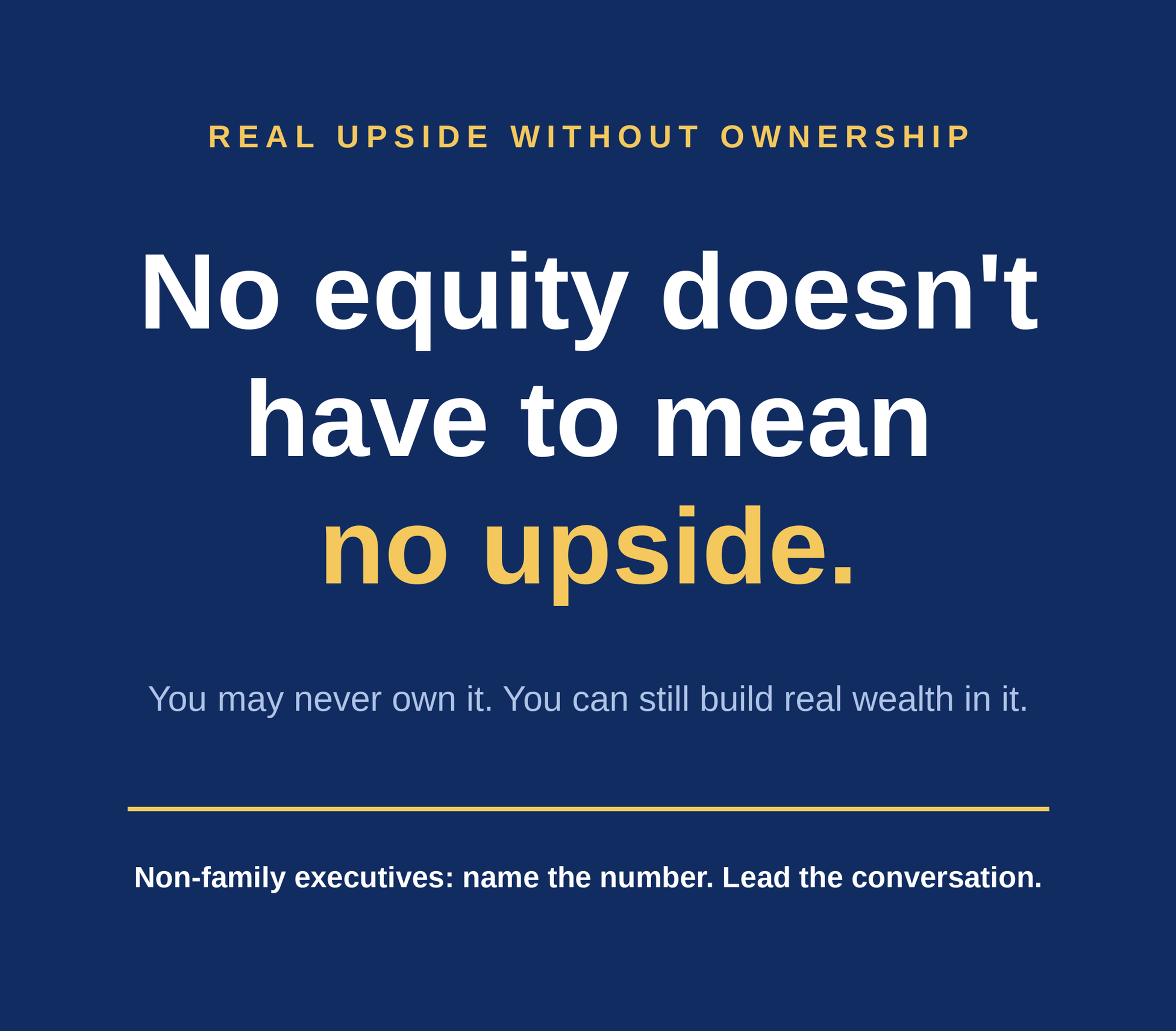
You may never hold equity. You might never be CEO. That’s worth being clear-eyed about. But no equity doesn’t have to mean no upside, and too many good leaders quietly assume it does.
I've seen the money conversation go sideways fast.
Raise it the wrong way and you sound like a hired gun who’s in it for the paycheck.
Raise it the right way and it’s a conversation about building the business together. Lead with what it does for the company, then talk about your share of it.
The ones who do well get specific, early:
They know their market value and make sure their pay reflects it.
They understand the tools. Phantom equity pays you as if you owned a slice of the company when it sells or on set dates, without handing over actual shares. A long-term incentive plan ties a multi-year bonus to growth in profit or company value.
They put it on the table instead of hoping it gets handled.
One way to open that conversation: “I want to be here for the long haul and help this business grow. Can we talk about how my rewards connect to the value I’m building?”
Most executives I coach want two things: the chance to build real wealth, and real impact in the place. Settle the first and you free up your head for the second. Neither happens by accident, and neither happens by waiting.
The lesson: The owner isn’t going to raise it for you. This one you have to lead.
Ask yourself: Do you know your options, and have you talked them through with the owner? Or are you still waiting for the right time?
5. See the succession curve
Nothing changes a non-family executive’s world faster than the day the founder starts to step back.
For years you build trust with one person.
![Two professional women in long coats standing together on wide stone steps outside an office building, with the caption “Their transition is your transition.”]](https://static.wixstatic.com/media/d5fa1b_57142145bf84428bbb0b83b06fed6559~mv2.jpg/v1/crop/x_0,y_15,w_1080,h_1335/fill/w_1080,h_1335,al_c,q_85,enc_auto/d5fa1b_57142145bf84428bbb0b83b06fed6559~mv2.jpg)
You learn how they think, what they’ll approve, and when to push. Then a son or daughter steps in, and the trust you earned has to be built all over again with someone new.
When I was hired as the non-family COO of a family-owned company, a major reason for the hire was to help facilitate the transition from the founder to the second generation. Knowing this going in helped me set expectations for what my role would look like through the transition, and it helped me navigate some challenging conversations between family members. Without that upfront conversation, I could have been confused by changing roles and blindsided by the generational handoff.
It’s easy to treat succession as the family’s business, not yours, right up until it reshapes your job without you. The better move is to see it coming:
Build a real relationship with the next generation before you need it.
Get clear on where you add value the family can’t easily replace.
Be ready to be the steady hand that helps the next leader succeed. For many, this becomes some of the most rewarding work of their career.
The lesson: Succession isn’t only the family’s transition. It’s yours too. The leaders who see it coming help steer it. The ones who don’t get steered by it.
Ask yourself: If the next generation took over tomorrow, would they already know what you’re worth? Or would you be starting from zero?
Get the free field guide
I wrote a short, practical field guide for anyone leading a business they’ll never own. It goes deeper on the pressures of this seat and ends with a 10-question self-assessment. Enter your name and email at deepdivelc.com/nfe and it opens right away.
If you’d rather talk it through
A client of mine, the non-family president of a multigenerational family manufacturer, described the seat this way:
“The hard part isn’t the operations. It’s the gap between what the title says you can do and what the family actually expects.”
And on working together:
“Most coaches haven’t lived that. He doesn’t tell you what you want to hear. He asks the question you’ve been avoiding.”
President, family-owned manufacturing company, Midwest
I’m always glad to talk. Book a free 45-minute call. No pitch, just a confidential conversation about the seat you’re in.
Frequently asked questions
What challenges do non-family executives face in family businesses?
The most common are: losing yourself in loyalty to a business you don’t own, isolation when the family disagrees, unwritten rules about who really decides, limited upside without equity, and having your role reshaped when the business passes to the next generation.
Can a non-family executive build wealth without owning equity?
Yes. Common options include market-rate pay, long-term incentive plans, phantom equity, and bonuses tied to the value the executive builds. The key is raising it early, framed around loyalty and the growth of the business, rather than waiting for the owner to bring it up.
How should a non-family executive prepare for a family business succession?
Treat succession as your transition too. Build a real relationship with the next-generation leader before you need it, get clear on the value you add that the family can’t easily replace, and have an upfront conversation about how your role will change.
How do you learn the unwritten rules in a family business?
Map who actually makes each kind of decision regardless of title, identify which topics are business and which are quietly family, and note whose trust you still need to earn. Write it down and keep watching.
Where can I get help as a non-family executive?
Deep Dive Leadership Consulting offers virtual, confidential 1:1 coaching for non-family executives nationwide, plus a free Non-Family Executive’s Field Guide at deepdivelc.com/nfe.
About the author

Bryan Van Itallie is the founder of Deep Dive Leadership Consulting, LLC and a Vistage Chair based in the Michiana area of Southern Michigan and Northern Indiana. He is a former U.S. Navy nuclear submarine officer, holds an MBA from Duke University, and has 30+ years of experience in manufacturing, leadership, and executive coaching, including senior roles at John Deere, Grace Technologies (where he served as the non-family COO), and PIC Trailers. He coaches non-family executives in family-owned businesses nationwide.
This post was adapted from Bryan’s fall 2026 LinkedIn series on leading as a non-family executive.

Comments